


Operator tools
QR code problem reporting for pinball and arcade machines
A broken game can earn little to nothing, and can frustrate players who might otherwise stay longer and play more. The fastest fix is letting the person standing at the machine tell you it broke. Here is how QR problem reporting works, why the DIY versions crack, and what a purpose-built flow looks like.
How operators find out a game is down today
Usually late, and usually by accident. The bartender means to text you and forgets by the third pour. Players flip the coin door card over or just move to the next game. The regular who has your number is not in this week. Most operators discover a dead flipper the same way they discover everything: standing in front of the machine on collection day, counting what a broken game did not earn.
Every silent day costs twice: the game earns less, and players who came to play leave frustrated instead of staying for another round. Venues notice that too.
The DIY versions, and where they crack
- The laminated "problems? text us" sign. Players do not text strangers. When one does, the message says "the pinball machine is broken" and now you get to guess which machine, at which venue, and what "broken" means.
- A form-builder QR code. A generic form is a real step up, and some operators run this for a while. The cracks show with scale: one form cannot know which machine was scanned unless you build and print a separate form per game, the answers pile up in a spreadsheet tab nobody watches at 11pm on a Saturday, there is no photo, and nothing connects the report to the machine's repair history.
Both versions fail the same test: the report loses the machine. The whole value of a fault report is that it arrives already attached to the right game at the right venue, the moment it happens.
What purpose-built QR reporting looks like
Each machine gets its own QR code. A player scans it and gets a report page in their phone's browser: no app, no account, no typing a location. The code itself carries the machine's identity, so the report cannot arrive ambiguous.
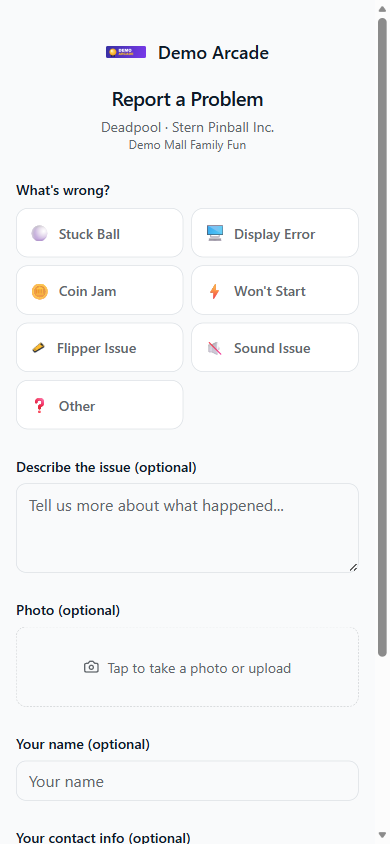
The page asks the player for the one thing only they know, what is wrong, as buttons: stuck ball, coin jam, flipper issue, display error, sound, will not start. Description, photo, and contact details are optional, because a report a player abandons half-way is worth less than a two-tap one they finish. The page carries the venue's name and branding, so it reads as the arcade's own page, not a third party's.
On your side, the report lands in the machine's issue list with the location attached, alongside the issues you log yourself. And it does not wait there quietly: Pinventory notifies your whole team on the channels you already watch, a push notification on each member's phone, an email, and a post to your Slack or Discord channel if you have one connected. Whoever is closest can pick it up.
Fix it, close it, and the repair joins that machine's history instead of evaporating in a text thread.
The card on the glass
The QR code needs a home on the machine, and a hand-cut printout reads as exactly that. Pinventory prints a card sized for the standard coin-door card holder, with the game title, your branding or the venue's, a contact line, and a note in your own words:
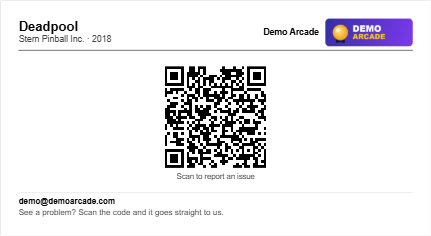
Prefer to design your own signage? The QR code also downloads on its own as SVG or PNG, so it drops into whatever the venue already prints.
What actually changes
- You hear the moment it happens. The report pushes to your phone, emails the team, and posts to your Slack or Discord, from the person standing at the game, instead of surfacing on collection day.
- Reports arrive complete. Machine, venue, category, and often a photo. No guessing which "the pinball machine" means.
- The venue stops being your messenger. Staff never reliably relayed problems, and now they do not have to.
- Every fix lands in the machine's history. Which game is a money pit stops being a feeling and becomes a record.
QR reporting is one piece of running a route on real records instead of memory. Why track your pinball business with software makes the whole case, and the route software chooser covers where issue tracking fits among the other tools.